
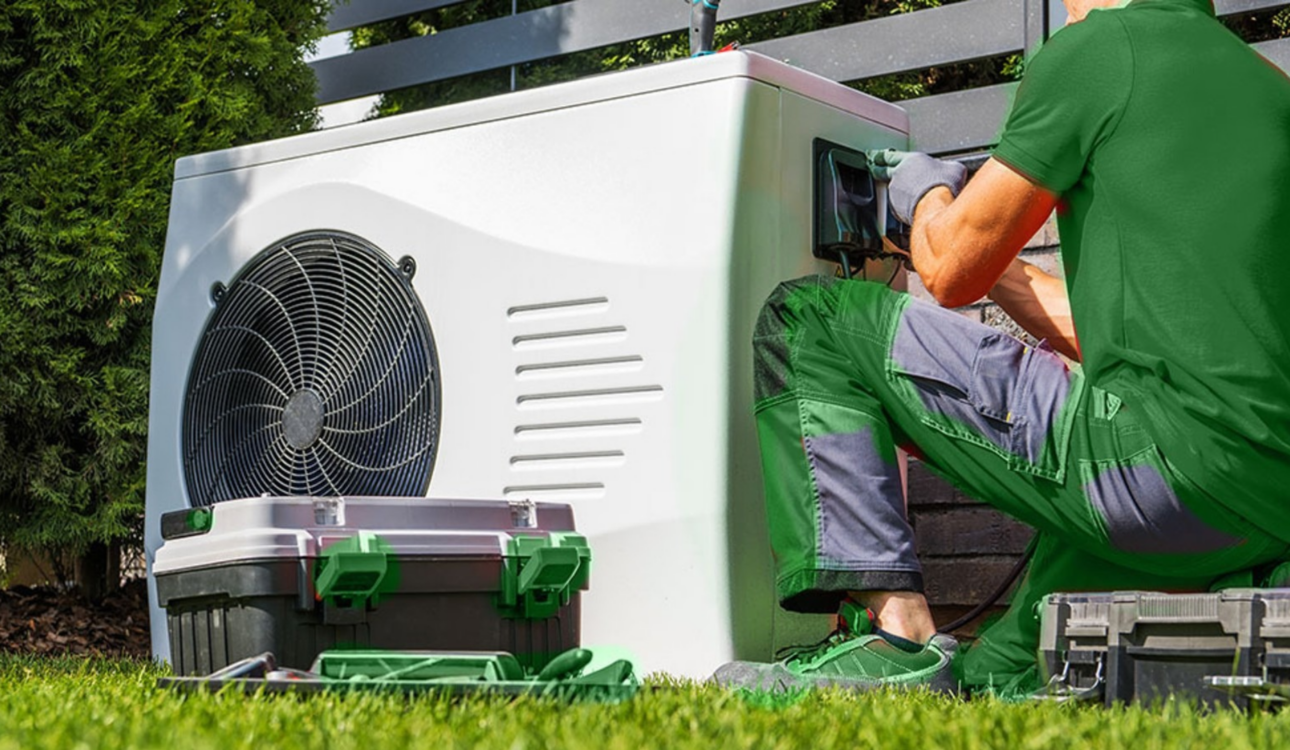
Yes. Air source heat pumps keep working well below freezing. Most are designed to run down to around -20°C. They become less efficient as it gets colder, and your bills go up on the coldest days. But they don’t stop.
There is still heat in cold air
Cold is not the absence of heat. Absolute zero is -273°C, so air at -5°C still holds a huge amount of heat energy. It just doesn’t feel like it.
A heat pump doesn’t burn anything. It moves heat. Inside it is a refrigerant that boils at an extremely low temperature, well below -40°C. Even freezing air is warm enough to boil it.
Once it’s a gas, the pump squeezes it. Squeezing makes it hot. That heat goes into your radiators and hot water.
It’s a fridge running backwards, taking heat out of your garden and dumping it into your house.
What actually changes in cold weather
Three things:
- Efficiency drops. On a mild day your heat pump might produce four units of heat for every unit of electricity. At -7°C that falls to roughly two to two and a half.
- It runs for longer. The house is losing more heat, so the pump works harder and for more hours.
- Your bill goes up. Same as any heating system in a cold snap, and weather like this is rare in Gloucestershire.
What doesn’t change is whether it works. It still heats the house.
Why it sometimes steams in winter
On a cold, damp morning you may see the outdoor unit steaming, or hear it change note for a few minutes.
That’s a defrost cycle. Frost builds up on the outdoor coil, so the unit briefly runs in reverse to melt it off, then carries on. It happens a few times on a frosty day and you’ll barely notice indoors.
The proof is in Scandinavia
If heat pumps failed in the cold, nobody in Norway would own one. Yet Norway, Sweden and Finland have the highest heat pump ownership in Europe, and their winters are far colder than anything Gloucestershire sees.
Systems here are sized for an outside temperature of around -3°C, meaning the worst case day, not an average one.
So what does go wrong?
When a heat pump struggles in winter, the cold is almost never the cause. The design is. The usual culprits:
- Undersized unit. Matched to the old boiler instead of the actual heat loss of the house.
- Radiators left as they were. Sized for a 70°C boiler, they can’t deliver the same heat at 45°C.
- Flow temperature set too high. Pushes efficiency down and running costs up.
- No proper heat loss survey. Everything above follows from this one.
A well designed system is comfortable in a cold snap. A badly designed one isn’t, and that difference is decided on the survey.
So ask any installer two questions:
- Will you do a room by room heat loss survey, and what outside temperature have you sized this for? Vague answers tell you plenty.
Common questions
What temperature do heat pumps stop working at?
Most air source heat pumps are rated to operate down to around -20°C, far colder than a typical UK winter.
Do heat pumps struggle in cold weather?
They become less efficient as it gets colder, but a correctly sized system still heats your home. Winter problems usually come from poor design, not the weather.
Why is my heat pump making a different noise in winter?
It’s most likely a defrost cycle, clearing frost from the outdoor coil. It lasts a few minutes and is completely normal.
How do I find air source heat pumps installers near me in Gloucestershire?
Look for an MCS certified installer who carries out a full heat loss survey before quoting.
Searching for air source heat pumps near me?
If you’re weighing one up for a Gloucestershire home, the cold isn’t the thing to worry about. The survey is.
We’re MCS certified and local, covering Gloucester, Cheltenham, Stroud, Tewkesbury and the Cotswold villages. Every installation starts with a room by room heat loss survey, so you know what size unit you need before you commit.
Call us on 01452 471031 or book a survey.